A Foolish and Fictitious Library
[RARITIES AND PROVERBS.]
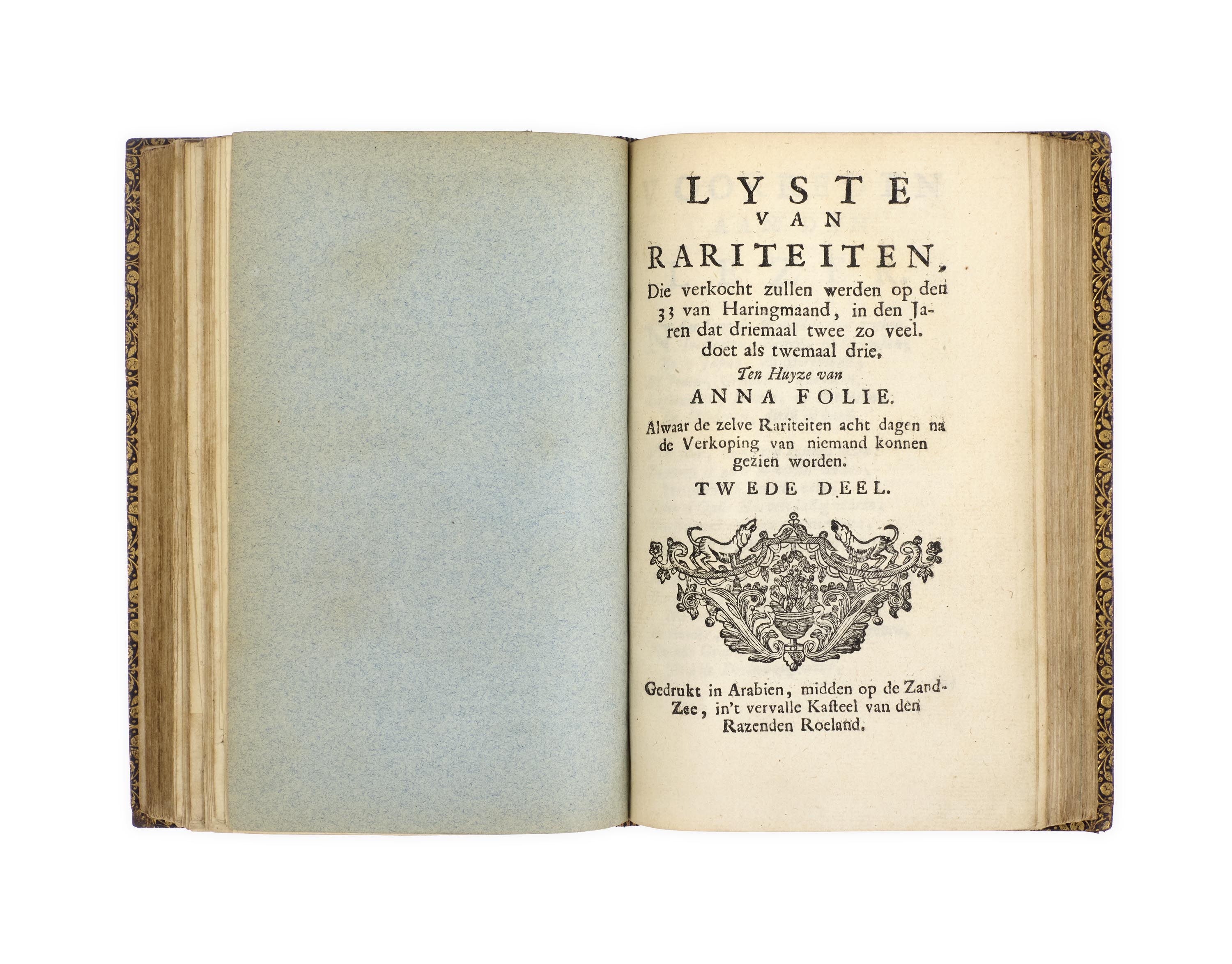
Lyste van Rariteiten, die verkocht zullen werden op den 32 van Bokkem-maand, in den Jaren dat tweemaal drie zoo veel doet als driemaal twee [– op den 33 van Haringmaand, in den Jaren dat driemaal twee zo veel doet als twemaal drie]. Ten Huyze van Anna Folie [– Twede Deel]. ‘Gedrukt in Arabien, midden op de Zand-Zee, in’t vervalle Kasteel van den razenden Roeland’ [i.e. Amsterdam?, 1706?].
[bound with:]
Lyste van Spreek-Woorden, op verscheyde voorvallen toepasselyk, door een Liefhebber der zelve by een vergadert. ‘Te Zeg-waardt, by Johannes Silentiarum, in Momus’ [– ‘Gedrukt in de Brouwery van de Weerelt, in de Drukkery van Kakodemus’] [i.e. Amsterdam?, 1706?].Four parts in one vol., 8vo, Rariteiten I: pp. 175, [1, blank], Spreek-Woorden I: pp. 48, Rariteiten II: pp. [iv], 170, Spreek-Woorden II: pp. [2], 173-220, the Spreek-Woorden extra-illustrated with 47 engraved plates of proverbs by Joachim Ottens of Amsterdam (42 in part I, 5 in part II, each with two images per plate); bound without the half-title to Rariteiten part I; woodcut ornament to each title-page, woodcut initials; occasional light marginal toning, a few small stains, but a very good copy; bound in nineteenth-century crushed brown morocco with the arms and monogram of William Stirling Maxwell blocked in blind to covers (BAB stamps 2 & 41), spine lettered directly in gilt, top edge gilt, others uncut; neat repairs to joints; bookplate of William Stirling Maxwell to front pastedown with his Keir bookplate to rear pastedown, bookplate of Lt. Col. V.S.M. de Guinzbourg to front free endpaper.
Added to your basket:
Lyste van Rariteiten, die verkocht zullen werden op den 32 van Bokkem-maand, in den Jaren dat tweemaal drie zoo veel doet als driemaal twee [– op den 33 van Haringmaand, in den Jaren dat driemaal twee zo veel doet als twemaal drie]. Ten Huyze van Anna Folie [– Twede Deel].
A bizarre series of fictitious auction catalogues of books and objects, the auctions taking place on impossible dates (‘the 32nd of smoked herring month’), followed by collections of proverbs; an extra-illustrated copy from the library of Sir William Stirling Maxwell.
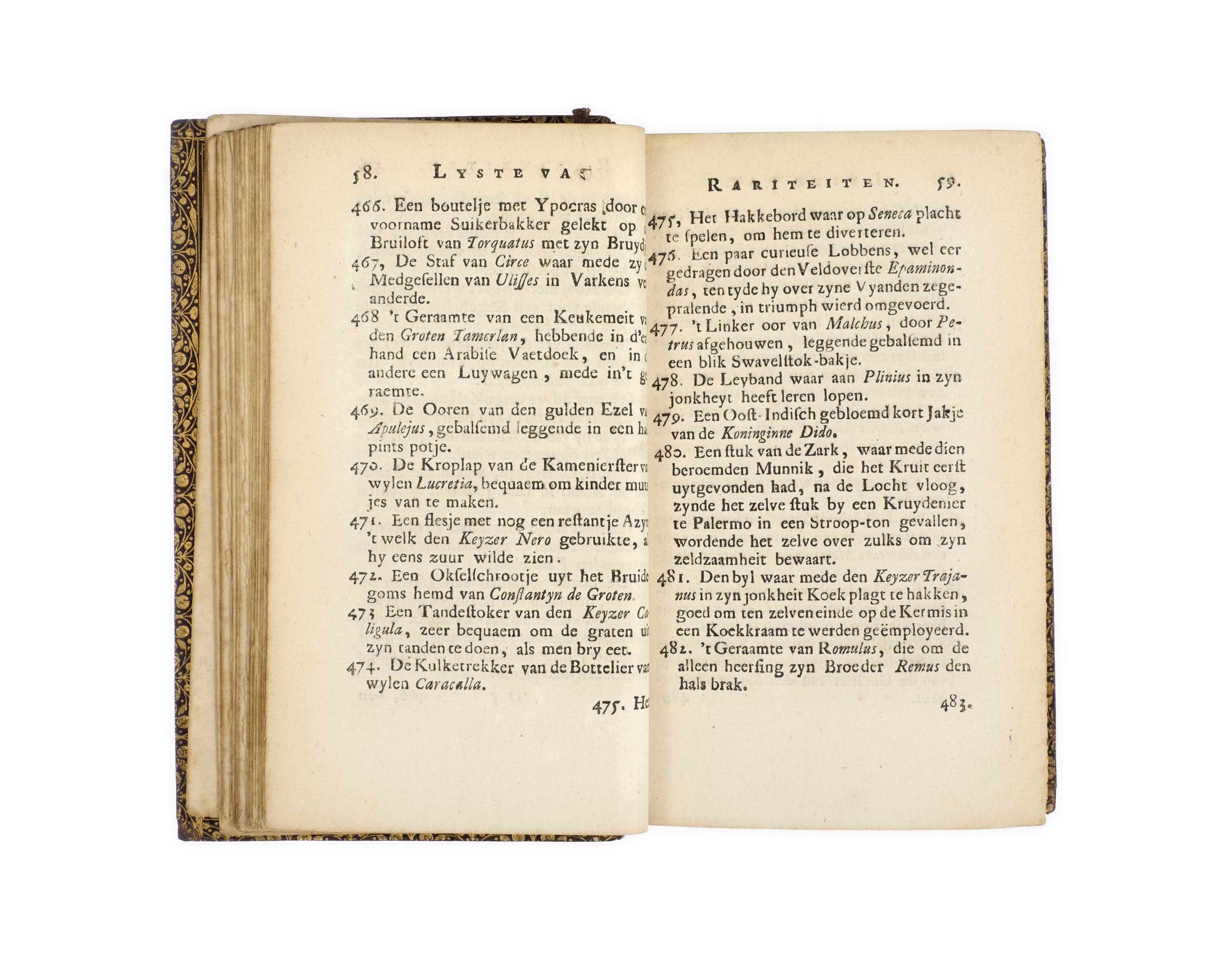
The fictitious auction catalogue is entitled ‘List of rarities that will be sold … at the house of Anna Folie, where the rarities cannot be seen by nobody three days after they have been sold’ (trans.) and provided with a similarly preposterous place of printing, ‘In Arabia, in the middle of the desert, in the ruined castle of raging Roland’. In line with contemporary auction catalogues, some of the books are arranged by size, and the entries are in a mix of roman, italic, and gothic typefaces. Alongside the books are pointless objects, from a bookcase without shelves to a harpsichord without a keyboard.
‘De Lapsak der Rechten, door Johannes Perverso, met kopere Platen, 2 voll.’
(The Codpiece of the Law, by John Bad, with copper plates, 2 vols.; part II, p. 34.)
‘Der Spekkookunst van Utopia, in drie Boeken beschreven door Johannes Porkius’
(The art of cooking bacon in Utopia, described in three books by John Piggy; part II, p. 35.)
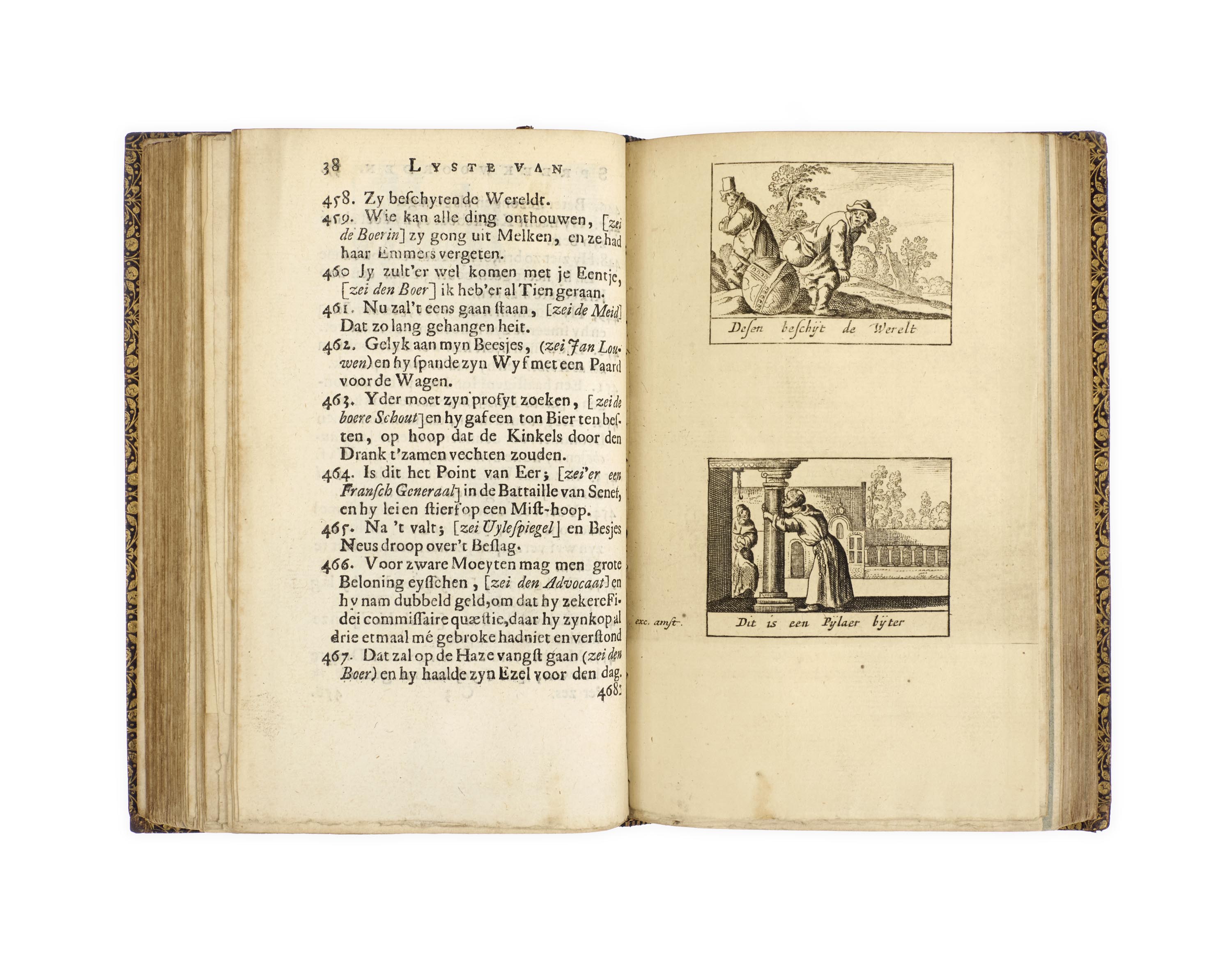
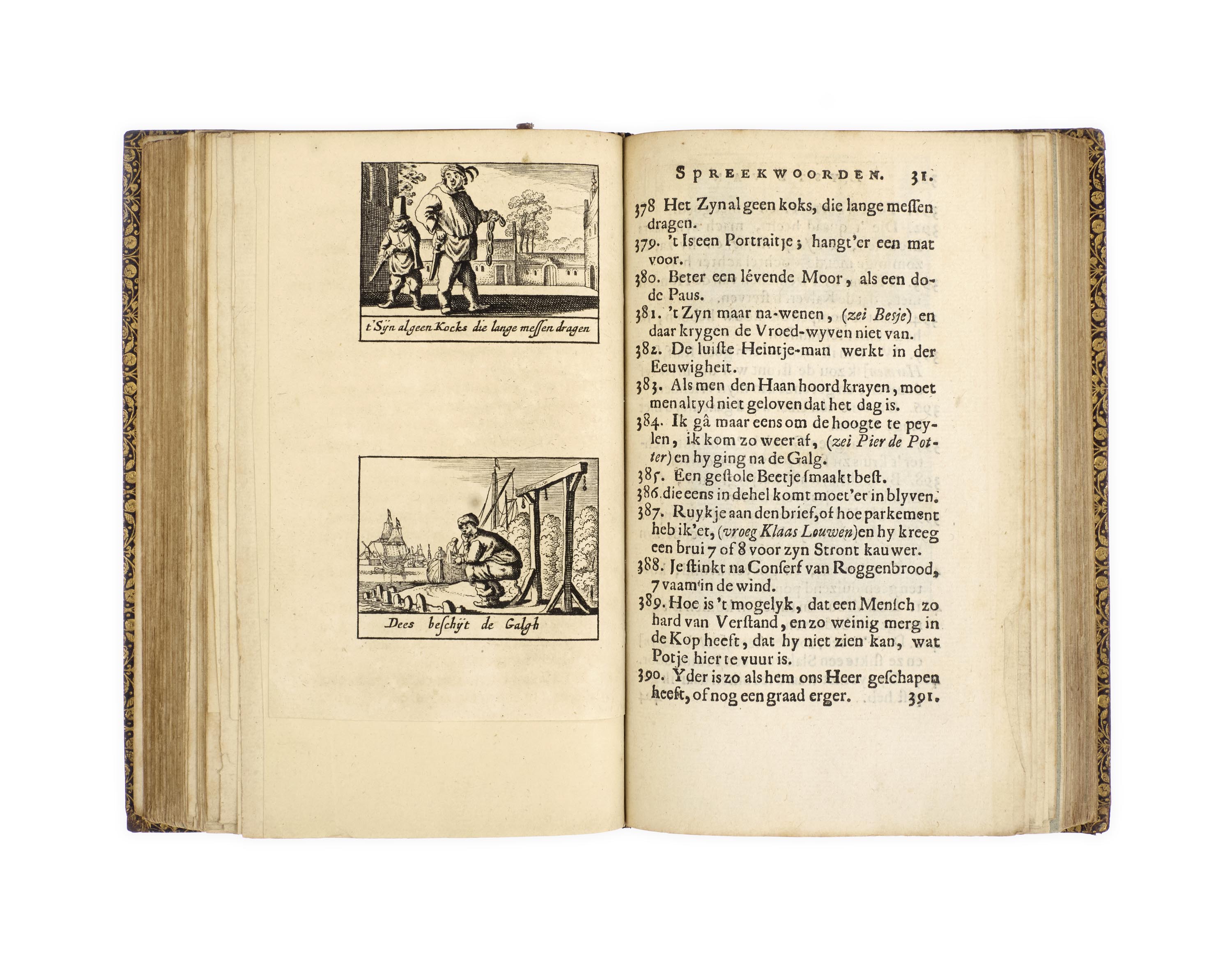
The two parts of the Spreek-Woorden, also provided with similarly bizarre imprints, contain more than a thousand proverbs, many of them vulgar or scatological. This copy has been extra-illustrated with engravings of proverbs, bound to face relevant parts of the text, by Joachim Ottens of Amsterdam. The plates have been cut from sheets of a series of popular prints, with traces of letters alongside the illustrations which were originally printed in the centre of each sheet of sixteen engravings; only the letters R, S, V, W, and X are visible, though some of the engravings were also on the sheet marked T. The Rijksmuseum in Amsterdam has uncut copies of the T and W sheets, and the Atlas van Stolk has just the T sheet (Katalogus der Historie-, Spot- en Zinneprenten betrekkelijk de Geschiedenis van Nederland 2127).
Among the engravings in the present volume, one entitled ‘De Geck is Broedts’ (The madman is broody, p. 176) shows a man trying to lay an egg, while another clearly illustrates ‘Dees beschÿt de Galgh’ (He shits on the gallows, p. 31).
The 1706(?) date of publication is suggested by STCN; it is likely that the books were printed sometime between 1699 and 1741, and the Rijksmuseum dates the engravings to 1689–1720. A variant with a different woodcut on the title-page was printed at around the same time.
Provenance:
1. Sir William Stirling Maxwell (1818–1878), with his Keir ‘Proverbs’ bookplate, indicating the section of the library at Keir House in which this book was located (though this volume is not in his 1860 catalogue of proverbs and emblems); his sale, Christie’s, 20 May 1958, in lot 801 (to Quaritch).
2. Victor de Guinzbourg (1906–1976) worked in intelligence for the US Army and served on the Military Staff Committee of the United Nations; he was a notable proverb enthusiast and collector.
We have found only one copy in the US (Indiana), and none in the UK; we have traced only three other single sheets of the engravings.
STCN 240550218 (Rariteiten part I), 375313095 (Rariteiten part II and Spreek-Woorden part II) & cf. 240554302 (Spreek-Woorden, but with different collation for part II). See Smith & Geirnaert, ‘Wieringa – Doedijns – Anna Folie – Van Lennep: Dutch versions of Rabelais’s Library of Saint-Victor’ in Early modern catalogues of imaginary books (2020), pp. 320–348.